Cast Coil Dry-Type Transformer Manufacturer — High Short-Circuit Strength with Custom Capacity Support
Time:2026-05-28 Auther:ZTelec-www.ztelectransformer.com
Cast coil dry-type transformers have become one of the most reliable and widely adopted transformer solutions in modern power distribution systems. With excellent short-circuit withstand capability, superior moisture-resistant insulation, and highly flexible custom design options, cast coil transformers are extensively used in rail transit, data centers, offshore engineering, renewable energy, heavy industry, and commercial infrastructure projects.
Compared with conventional VPI dry-type transformers, cast coil transformers provide a fully encapsulated solid insulation structure that significantly improves mechanical strength, operational safety, and long-term reliability. For projects operating in humid, polluted, high-load, or high short-circuit environments, cast coil dry-type transformers are often the preferred solution.
This article explores the manufacturing process, technical advantages, customization capabilities, and supplier evaluation criteria of cast coil dry-type transformers, helping engineers, EPC contractors, and procurement managers select the right transformer manufacturer for demanding applications.

What Is a Cast Coil Dry-Type Transformer?
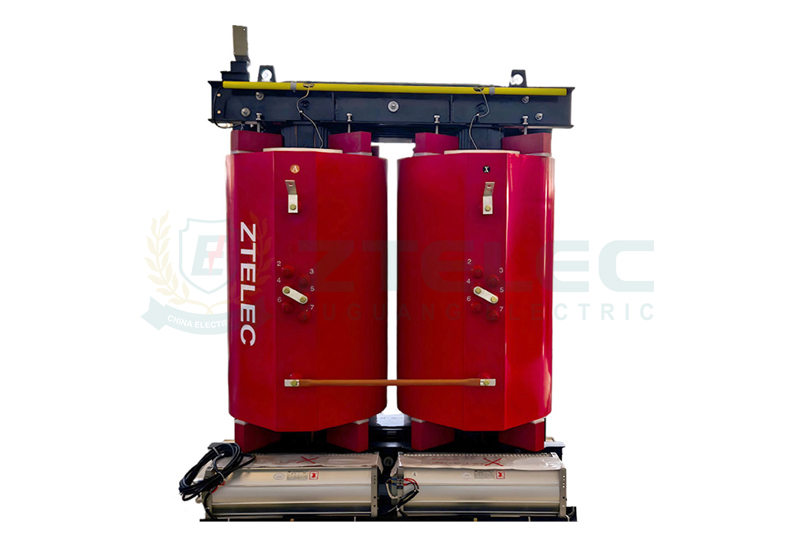
A cast coil dry-type transformer, also known as an epoxy resin cast transformer, is a high-performance dry-type transformer that uses vacuum casting technology to encapsulate transformer windings with epoxy resin.
During manufacturing, the high-voltage and low-voltage coils are placed into dedicated molds. Under deep vacuum conditions, typically below 1 mbar, heated epoxy resin mixed with curing agents is injected into the mold cavity. After a carefully controlled curing process, the resin solidifies and forms a rigid cylindrical insulation structure around the windings.
This fully sealed insulation system completely isolates the windings from moisture, dust, salt spray, and industrial contaminants, creating an extremely stable solid insulation structure with outstanding mechanical strength.
Unlike VPI (Vacuum Pressure Impregnation) transformers or open ventilated dry-type transformers, cast coil transformers provide superior environmental resistance and mechanical stability, especially under severe operating conditions.
High-quality cast coil dry-type transformers manufactured according to IEC 60076-11 and GB/T 10228 standards can satisfy:
C2 climate classification for severe environmental conditions.
E2 environmental classification for high pollution resistance.
F1 fire behavior classification for fire safety requirements.
These certifications make cast coil transformers ideal for underground substations, transportation infrastructure, offshore projects, and critical industrial applications.
Advanced Vacuum Casting Manufacturing Process
Precision Coil Winding
The manufacturing process begins with precision winding of high-voltage and low-voltage coils using copper foil or aluminum foil conductors. Modern CNC winding machines ensure accurate turn spacing, consistent axial dimensions, and optimized electromagnetic balance.
Uniform winding geometry is essential for achieving high dielectric strength and strong short-circuit performance.
Vacuum Drying and Pre-Treatment
Before casting, the wound coils are placed inside a vacuum drying oven at temperatures between 120°C and 140°C for 8 to 12 hours. This process removes residual moisture and trapped gases inside the insulation layers.
Proper drying prevents bubbles and voids from forming during resin casting, which is critical for achieving low partial discharge levels and long-term insulation reliability.
Vacuum Resin Casting
After drying, the coils are transferred into a vacuum casting chamber where preheated epoxy resin is injected under vacuum conditions. The resin penetrates every insulation gap and conductor layer, eliminating air pockets and ensuring complete encapsulation.
Premium cast coil transformer manufacturers use low-halogen, flame-retardant epoxy resin systems with excellent thermal and mechanical properties.
Controlled Thermal Curing
The curing process follows a precise temperature profile, typically involving multiple heating stages such as 80°C, 120°C, and 160°C. This controlled curing sequence ensures complete resin polymerization and maximizes mechanical stability.
After curing, the cast coil forms a solid monolithic insulation structure capable of withstanding severe thermal cycling and mechanical stress.
Machining and Quality Inspection
Once the casting process is completed, the coils are demolded, machined, polished, and dimensionally inspected. Each cast coil undergoes electrical testing, partial discharge measurement, and insulation verification before final transformer assembly.
Why Cast Coil Transformers Offer Superior Short-Circuit Strength
Short-circuit withstand capability is one of the most critical mechanical performance indicators for dry-type transformers. During external short-circuit faults, transformer current may instantly rise to 8 to 25 times the rated current, generating extremely strong electromagnetic forces inside the windings.
These forces create both axial compression and radial expansion stresses that can permanently deform conventional transformer windings.
Solid Encapsulation Prevents Conductor Movement
In cast coil transformers, every conductor turn is completely fixed inside the cured epoxy resin structure. Unlike open winding systems, individual conductors cannot move under fault current impact.
This rigid encapsulation eliminates the risk of conductor displacement, inter-turn short circuits, and insulation collapse during severe network faults.
Excellent Axial Compression Resistance
The cured resin structure behaves like a single integrated mechanical component with extremely high axial compression strength. This allows cast coil transformers to withstand powerful axial short-circuit forces without coil deformation.
Strong Radial Constraint Capability
The outer epoxy casting layer provides circumferential reinforcement that suppresses radial expansion during fault events, significantly improving transformer mechanical stability.
According to IEC 60076-5 short-circuit withstand standards, high-quality cast coil dry-type transformers can successfully pass peak short-circuit current testing, demonstrating exceptional structural reliability.

Applications Requiring High Short-Circuit Strength
Cast coil dry-type transformers are widely used in applications where high fault currents and demanding operating conditions require maximum transformer reliability.
Typical applications include:
Large-scale data centers with UPS systems and harmonic-rich nonlinear loads.
Urban rail transit systems and metro traction substations.
Steel mills, aluminum smelters, and heavy industrial facilities.
Offshore wind power platforms and marine substations.
Hospitals, airports, and mission-critical infrastructure.
Mining, rolling mills, and high-impact industrial processes.
Custom Capacity and Flexible Engineering Design
Professional cast coil dry-type transformer manufacturers provide extensive customization capabilities to meet the requirements of complex engineering projects.
Wide Capacity Range
Mainstream manufacturers typically offer:
Standard capacity range from 100 kVA to 20,000 kVA.
Custom-engineered transformers exceeding 40,000 kVA.
Voltage levels from 0.4 kV to 35 kV, with custom solutions available up to 66 kV.
Common Customization Options
| Customization Item | Available Options |
|---|---|
| Rated Capacity | Custom non-standard capacities |
| Impedance Voltage | 4%, 5%, 6%, 8%, 10% or customized values |
| Insulation Class | Class F (155°C) or Class H (180°C) |
| Cooling Method | AN, AF, or AN/AF combined cooling |
| Protection Degree | IP00, IP20, IP23, IP54, IP65 |
| Conductor Material | Copper, aluminum, or mixed winding design |
| Tap Changer | Off-circuit taps or OLTC on-load tap changer |
| Harmonic Capability | K-factor design such as K-13 or K-20 |
| Special Certifications | UL, CSA, CE, CCC, DNV GL |
Engineering Design Process
Professional manufacturers usually follow a complete engineering workflow that includes technical requirement analysis, electromagnetic design, thermal simulation, short-circuit verification, customer approval, production, type testing, and factory acceptance testing.
Standard production lead times are typically 8 to 12 weeks, while complex custom-engineered transformers may require 14 to 20 weeks.
How to Evaluate a Cast Coil Transformer Manufacturer
Vacuum Casting Equipment Capability
Leading manufacturers operate large-scale vacuum casting systems capable of maintaining deep vacuum levels between 0.1 and 1 mbar. The size and capability of the casting chamber determine the maximum transformer capacity that can be produced.
Third-Party Type Test Reports
Reliable manufacturers should provide complete type test reports issued by internationally recognized laboratories such as KEMA, CESI, or national power research institutes.
Key test items include:
Temperature rise test.
Short-circuit withstand test.
Lightning impulse test.
Partial discharge measurement below 10 pC.
Quality Certifications
Professional manufacturers should maintain internationally recognized quality systems including:
ISO 9001 quality management certification.
ISO 14001 environmental management certification.
IEC 60076-11 compliance.
UL 1561 certification for North American markets.
Industry Project References
Manufacturers with proven experience in metro systems, offshore engineering, renewable energy, and data center projects are generally more capable of delivering reliable long-term transformer performance.
After-Sales Technical Support
Strong technical documentation, spare parts support, and localized service capability are essential for reducing lifecycle operating costs and minimizing downtime.
Avoid Low-Quality Low-Price Products
Some low-cost suppliers claim to provide cast coil transformers but actually use non-vacuum casting processes or inferior resin materials.
A reliable method to identify product quality is to request factory partial discharge test records for each transformer. Partial discharge values exceeding 20 pC may indicate internal voids or poor casting quality, which significantly increase insulation failure risk.
Typical Applications of Cast Coil Dry-Type Transformers
Cast coil transformers are widely used in modern infrastructure and industrial power systems.
Common applications include:
Urban metro and rail transit substations.
Large hyperscale data centers.
Hospitals and public buildings requiring F1 fire safety classification.
Offshore platforms and marine vessels exposed to salt spray and humidity.
Wind power and photovoltaic energy systems.
Heavy industrial environments with high short-circuit stress.
Cast coil dry-type transformers have established themselves as the leading solution for high-reliability dry-type transformer applications. Their exceptional short-circuit withstand capability, superior moisture-resistant insulation, and flexible custom engineering options make them ideal for demanding industrial and infrastructure projects.
Choosing a professional transformer manufacturer with advanced vacuum casting technology, internationally recognized type test certifications, and proven engineering experience is essential for ensuring safe and reliable long-term transformer operation.
When evaluating suppliers, procurement teams should prioritize complete type test reports, low partial discharge performance, customization capability, and proven industry references rather than focusing only on purchase price.