Cast Resin Transformers: Encapsulated vs Cast Coil Types and Applications
Time:2026-04-9 Auther:ZTelec-www.ztelectransformer.com
Revolution in Dry-Type Transformer Insulation: Why Cast Resin Became Mainstream
Throughout the development of power equipment, each innovation in transformer insulation technology has significantly enhanced grid safety. Prior to the mid-20th century, oil-immersed transformers dominated all voltage levels from distribution to transmission. With accelerating urbanization and increasing building density, the fire and oil leakage risks of oil-immersed equipment in indoor, underground, and densely populated areas drove engineers to explore new insulation solutions.
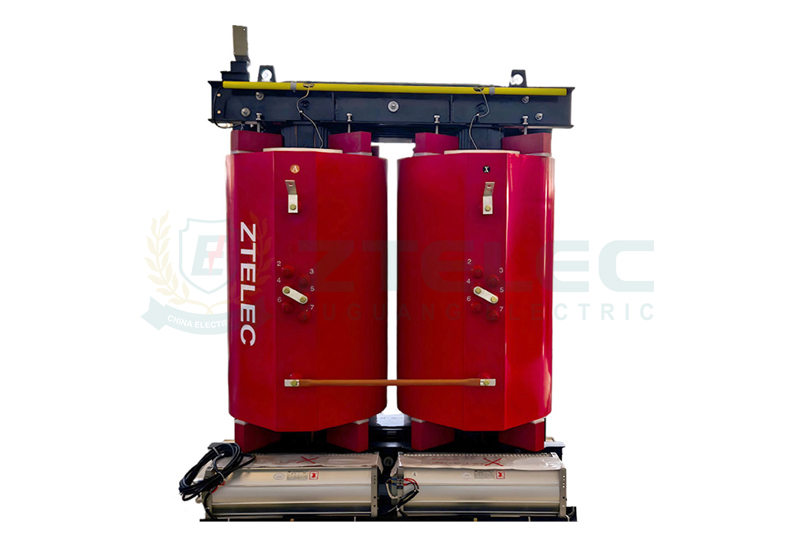
Cast Resin Transformers (CRT) emerged as a safe alternative. Using epoxy or unsaturated polyester resin as the primary insulation medium, coils are fully cast in a vacuum, completely eliminating flammable liquids. With advantages such as fire resistance, low maintenance, and strong environmental adaptability, CRTs first spread across Europe and gradually became the preferred dry-type transformer for urban distribution networks, industrial sites, and renewable energy projects worldwide.
CRT is not a single product concept. Based on coil encapsulation, it can be divided into fully encapsulated cast type and semi-encapsulated type. In practice, the most common classification is by coil structure—encapsulated coil and cast coil. Although both use resin insulation, they differ significantly in manufacturing, electrical performance, mechanical characteristics, and application scenarios. Understanding these types is crucial for accurate engineering selection.

Casting Principles and Core Manufacturing Processes
Core manufacturing processes for CRTs include vacuum pressure impregnation (VPI) and vacuum casting, each affecting the final product performance.
Vacuum Casting Process (Fully Encapsulated Type)
In fully encapsulated CRTs, the wound coil is placed in a mold under high vacuum, preheated and dried, then low-viscosity epoxy resin is slowly injected under vacuum or low-pressure inert gas. After curing, the result is a solid, one-piece insulated coil. This process ensures complete resin penetration and bubble-free insulation, eliminating partial discharge (PD) risk. High-quality encapsulated coils can achieve PD levels below 5pC, far exceeding typical oil-immersed transformer performance.
Open Casting Process (Cast Coil Type)
Cast coil transformers use glass fiber grids or insulation spacers during winding to create ventilation channels. Resin is applied only to the coil surface, leaving internal air passages open. This design allows natural or forced convection for effective cooling, making it ideal for high-capacity or overload applications.
Both methods are suited to different requirements: low PD and high insulation reliability favor full encapsulation; high overload or large capacity favors open cast coils.
Encapsulated Coil vs Cast Coil Technical Comparison
| Parameter | Fully Encapsulated Coil | Open Cast Coil |
|---|---|---|
| Insulation Medium | Epoxy fully sealed | Resin shell + internal air channels |
| Partial Discharge | <5pC (factory test) | Relatively higher, depends on process |
| Cooling Method | Thermal resin + external convection | Internal air channels, forced/natural convection |
| Overload Capacity | Limited by resin thermal conductivity | High, up to 150% short-term rated current |
| Moisture & Dust Protection | Excellent, up to IP54 | Good, requires dust prevention design |
| Fire Rating | F1 (IEC 60076-11) | F1 (IEC 60076-11) |
| Temperature Class | B, F, H options | F, H mainly |
| Typical Capacity Range | 25kVA–10MVA | 630kVA–63MVA+ |
| Typical Voltage Range | 6kV–36kV | 10kV–72.5kV |
| Maintenance | Minimal, maintenance-free | Low, periodic cleaning required |
Insulation Class, Fire Rating, and Standards
CRT design and testing follow IEC 60076-11, and in China GB/T 10228. Temperature classes include B (80K), F (100K), and H (125K), with H-rated coils suited for higher ambient temperatures or overloads. Fire rating F1 ensures compliance with indoor distribution safety, and some halogen-free epoxy systems meet UL 1561 for North America. Wind power transformers follow IEC 60076-16, ensuring resistance to vibration, salt spray, and humidity.

Typical Applications
Urban Rail Transit: Fully encapsulated CRTs are widely used in subway and light rail traction substations. F1 fire rating, non-flammable design, and maintenance-free operation make them mandatory in underground stations. Typical capacities 1250–3150kVA, voltage 35kV/0.75kV or 10kV/0.415kV.
Data Centers & Critical Infrastructure: Fully encapsulated CRTs dominate large-scale data centers, with IP34–IP54 protection, low noise (<45dB in some products), and controlled PD. Typical capacities 2500–5000kVA, H-class insulation, used in APAC tech campuses.
Wind Power Step-Up Systems: Onshore/offshore CRTs in turbine nacelles are compact, vibration-resistant, salt-fog resistant, and moisture-proof. Typical step-up voltage 690V/35kV, capacity 3.3–16MW matching turbine rating.
Industrial & Special Sites: Petrochemical, hospitals, high-rise buildings, museums adopt CRTs for fire safety. Hospital isolation transformers usually 10–63kVA encapsulated type with insulation monitoring for medical IT systems.
Loss Control & Energy Efficiency
Traditional CRTs use cold-rolled silicon steel cores with higher no-load loss. Replacing with amorphous alloy cores can reduce no-load loss by over 70%. GB 20052-2020 mandates energy efficiency, with 1st-level products requiring amorphous core-level losses. High-efficiency CRTs can recover investment through energy savings in 5–8 years.
Installation, Operation & Maintenance
“Maintenance-free” refers to no need for oil sampling, chromatography, or filtration as in oil-immersed units. Fully encapsulated CRTs suit altitudes below 1000m; high-altitude versions up to 4000m. Transformer room ventilation, height, and airflow must meet manufacturer requirements. Annual cleaning is recommended, focusing on core grounding, temperature sensors, cooling fans, and surface resin micro-cracks. High-salt or dusty environments require quarterly cleaning. Operating temperature should not exceed 155°C for H-class transformers.
Market Trends: Smart, SF6-Free, and Green Manufacturing
CRT market is advancing in smart monitoring, digital operation, and green manufacturing. New units integrate temperature sensors, PD monitoring, and vibration sensors, connecting via IoT platforms for condition monitoring and life prediction. Biobased epoxy resins reduce lifecycle carbon emissions by 30–50%. Advances in solid insulation and vacuum casting enable 110kV dry-type transformers for urban substations.
Engineering Selection & Common Pitfalls
Avoid over-specifying insulation class; choose based on actual load and environment. Consider noise levels in sensitive locations and request A-weighted noise reports or vibration-reduction design. Short-circuit impedance must align with system voltage regulation and load power factor.
Cast resin transformers offer unique advantages for urban distribution, industrial supply, and renewable energy integration. Fully encapsulated types excel in insulation reliability and maintenance-free operation, ideal for underground, data centers, and rail transit. Open cast coil types provide overload capacity and scalable sizes for industrial and renewable step-up applications. Amorphous cores, smart sensors, and green materials drive evolution toward higher voltage, lower losses, and intelligent operation, ensuring safe, efficient, and low-carbon urban power systems.