Oil-Immersed Autotransformer Explained: Design, Features, and Typical Applications
Time:2026-01-13 Auther:ZTelec-www.ztelectransformer.com
In power transmission and distribution systems, oil-immersed autotransformers are widely applied due to their compact structure, high operating efficiency, and relatively low manufacturing cost. They are especially suitable for systems where voltage levels are close and electrical isolation is not a primary requirement.
Typical applications include interconnection of power networks with similar voltage ratings, system capacity expansion projects, and industrial power supply scenarios. This article explains oil-immersed autotransformers from an engineering perspective, focusing on design principles, structural characteristics, performance features, and practical application scenarios.

Overview of Oil-Immersed Autotransformers
An oil-immersed autotransformer is a transformer in which the high-voltage and low-voltage sides share a portion of the same winding. Unlike a conventional two-winding transformer, there is no complete electrical isolation between primary and secondary circuits.
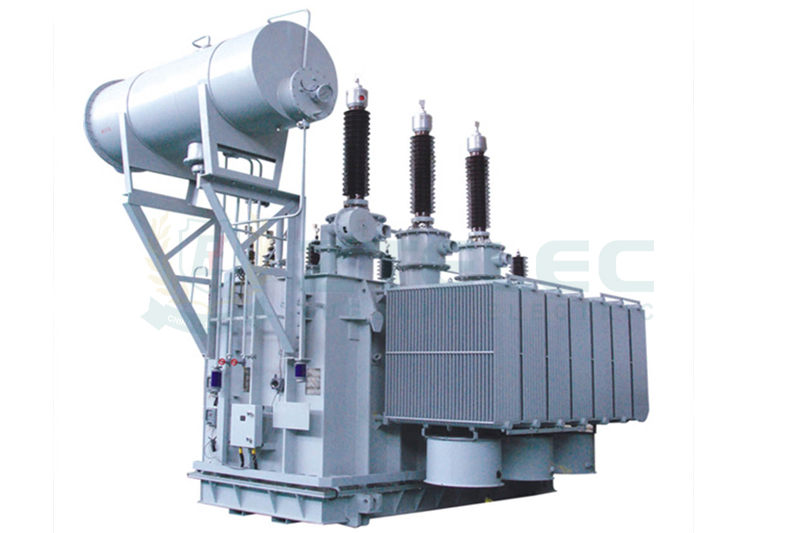
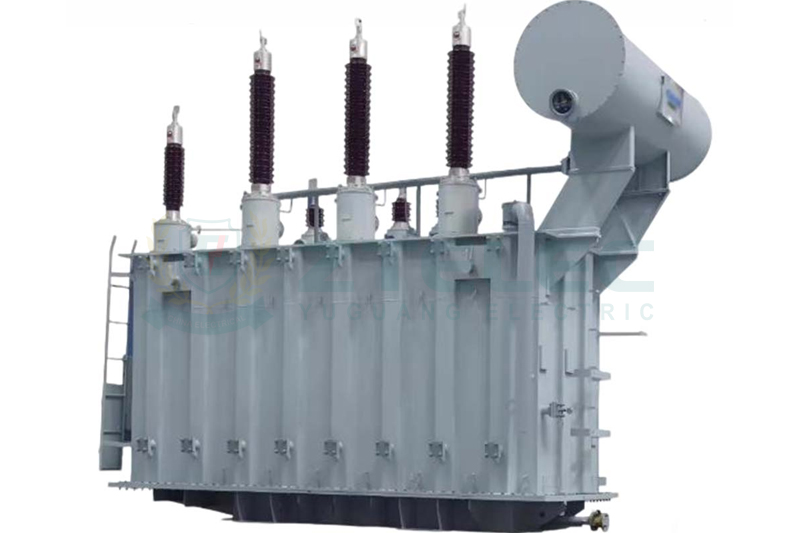
The core and windings are fully immersed in transformer oil. The oil acts as both an insulating medium and a cooling medium, providing effective electrical insulation while dissipating heat generated during operation. Compared with double-winding transformers of the same rating, autotransformers require less copper and insulation material, which results in higher efficiency and reduced size.
Design Principles of Oil-Immersed Autotransformers
In a conventional two-winding transformer, energy is transferred solely through electromagnetic induction between electrically isolated windings. In contrast, an autotransformer uses a single continuous winding that functions simultaneously as part of both the primary and secondary circuits.
The supply voltage may be applied across the entire winding, while the load is connected to a portion of the same winding. In this configuration, energy transfer occurs through two mechanisms. Part of the power is transferred directly by electrical conduction through the shared winding, while the remaining portion is transferred through electromagnetic induction.
The ratio between conducted power and induced power depends on the voltage ratio. When the voltage difference between input and output is small, the proportion of conducted power increases, which explains the high efficiency and material savings of autotransformers.
The oil-immersed design places the core and windings inside a sealed steel tank filled with insulating oil. This structure ensures reliable insulation, stable temperature control, and long-term operational reliability.
Main Features of Oil-Immersed Autotransformers
One of the most important features of oil-immersed autotransformers is reduced material usage. Because part of the winding is shared, less copper and insulation material are required compared with two-winding transformers.
Lower material consumption directly leads to lower manufacturing cost for the same power rating. At the same time, reduced winding resistance results in lower load losses and higher overall efficiency.
The compact and lightweight structure makes oil-immersed autotransformers easier to transport and install, which is particularly beneficial for substation expansion and retrofit projects. In addition, stable voltage regulation can be achieved through off-load or on-load tap changers, depending on system requirements.

Typical Applications of Oil-Immersed Autotransformers
In high-voltage transmission systems, oil-immersed autotransformers are commonly used to interconnect networks with similar voltage levels, such as 220 kV to 110 kV or 500 kV to 330 kV. Their high efficiency and compact design make them suitable for large-capacity power transfer between regional grids.
In industrial power systems, autotransformers are frequently used for starting large AC induction motors, including pumps, fans, and compressors. By supplying reduced voltage during startup, the autotransformer limits inrush current and mechanical stress. Once the motor reaches near-rated speed, the system switches to full-voltage operation.
Oil-immersed autotransformers are also used in test stations and laboratories where continuously adjustable voltage is required. In these cases, the autotransformer allows smooth voltage regulation from zero up to rated voltage, supporting testing and calibration tasks.
In power grids, on-load tap changer transformers used for automatic voltage regulation are often based on autotransformer structures. Combined with on-load tap changers, they enable continuous voltage adjustment without interrupting power supply.
Oil-immersed autotransformers are best suited for applications where efficiency, compact size, and cost-effectiveness are key priorities. However, electrical isolation requirements must be carefully evaluated. If isolation is necessary to prevent fault propagation or ensure system safety, a two-winding transformer should be selected instead.
Voltage ratio is another important factor. Autotransformers provide the greatest advantage when the voltage ratio is relatively small, typically not exceeding 2:1. As the voltage ratio increases, the material and cost benefits gradually decrease.
For high-voltage grid interconnections, industrial motor starting, and voltage regulation applications where isolation is not required and voltage levels are close, oil-immersed autotransformers offer a reliable and efficient solution. A clear understanding of their design principles and application boundaries helps optimize power system design and reduce overall project costs.