What Is an Oil-Immersed Autotransformer? Structure and Performance Overview
Time:2026-01-12 Auther:ZTelec-www.ztelectransformer.com
In modern power transmission and distribution networks as well as large-scale industrial power systems, oil-immersed autotransformers are widely adopted for grid voltage regulation, high-capacity power transmission, and interconnection between power systems. Thanks to their compact structure, high operating efficiency, and relatively low equipment cost, oil-immersed autotransformers play an important role in medium- and high-voltage applications. This article provides a comprehensive overview of the definition, structure, working principle, and performance characteristics of oil-immersed autotransformers, serving as a practical reference for engineers and procurement professionals.

What Is an Oil-Immersed Autotransformer?
An oil-immersed autotransformer is a type of transformer in which the primary and secondary sides share a portion of the same winding. The magnetic core and windings are completely immersed in insulating oil, which functions as both a cooling medium and an electrical insulation material.
Compared with traditional two-winding transformers, autotransformers achieve voltage transformation through a shared winding structure. This design significantly reduces copper usage and power losses, resulting in smaller size, lighter weight, and higher efficiency. Oil-immersed autotransformers are especially suitable for large-capacity transmission systems where the voltage difference between input and output is relatively small.
Working Principle of an Oil-Immersed Autotransformer
When voltage is applied to the transformer winding, the common portion of the winding carries only the difference between the primary and secondary currents. Power transmission within an oil-immersed autotransformer consists of two simultaneous processes.
Part of the electrical energy is transferred directly through the conductive connection of the shared winding, which is known as conduction transfer. The remaining portion of the power is transferred through electromagnetic induction between winding sections. Voltage regulation is achieved by adjusting the tap positions on the winding, allowing the output voltage to change according to system requirements.
Main Structural Components of an Oil-Immersed Autotransformer
Magnetic Core
The core is typically manufactured from cold-rolled grain-oriented silicon steel sheets to minimize hysteresis and eddy current losses. It provides mechanical support for the windings and serves as a low-reluctance path for magnetic flux.
Common Winding
The defining feature of an autotransformer is the common winding shared by both the primary and secondary sides. Voltage adjustment is achieved by changing the effective turns ratio through tap positions on this winding.
Oil Tank and Insulating Oil
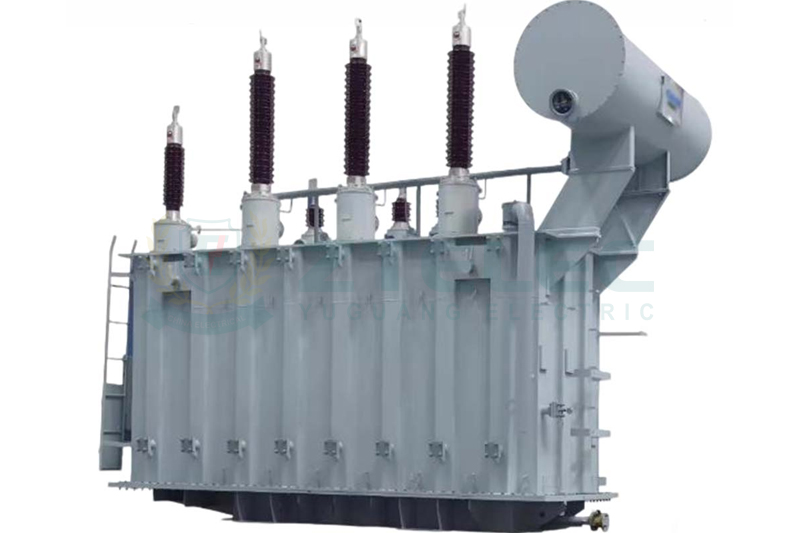
The oil tank is filled with high-quality insulating oil, which provides electrical insulation for live components and efficient heat dissipation during operation. The oil also helps extend insulation life and improve operational reliability.
Tap Changer
Tap changers are key components for voltage regulation and are available in on-load and off-load types. On-load tap changers allow voltage adjustment without interrupting power supply, which is essential for grid regulation applications.
Auxiliary Components
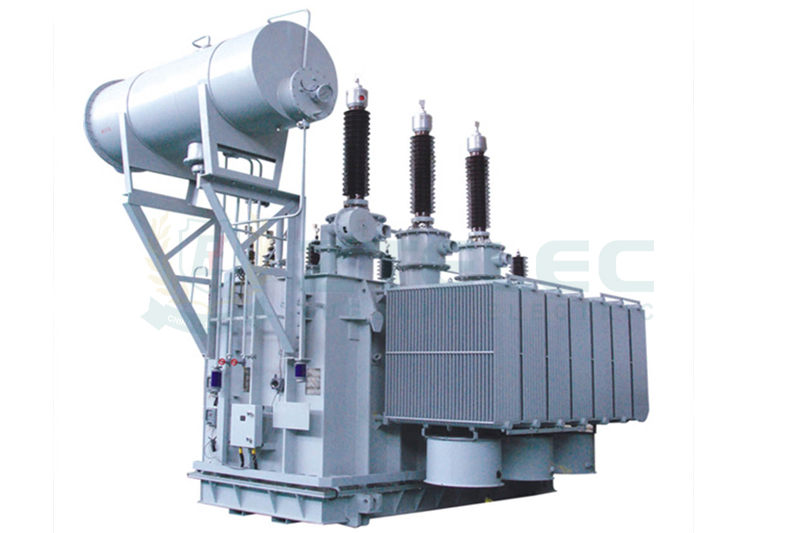
Auxiliary components include oil conservators, insulating bushings, cooling systems, and monitoring devices. The oil conservator compensates for oil volume changes caused by temperature variations, while insulating bushings provide safe electrical isolation between internal conductors and the transformer tank.

Performance Characteristics of Oil-Immersed Autotransformers
Oil-immersed autotransformers offer high efficiency due to their shared winding design, which results in lower copper losses compared with two-winding transformers. Their compact structure leads to reduced installation space requirements and lower transportation costs.
By using fewer conductive and insulation materials, oil-immersed autotransformers achieve lower overall manufacturing costs. When equipped with on-load tap changers, they provide excellent voltage regulation capability under varying load conditions. The oil-immersed design ensures effective heat dissipation, supporting stable long-term operation even in high-capacity transmission systems.
Typical Applications of Oil-Immersed Autotransformers
In grid interconnection projects, oil-immersed autotransformers are commonly used to link transmission systems operating at different but similar voltage levels, such as 220 kV and 110 kV networks.
They are also widely applied in power plants as starting transformers for large generator units, providing reliable auxiliary power during startup. In industrial environments, oil-immersed autotransformers support continuous voltage regulation for processes that demand stable and adjustable power supply.
In railway electrification systems, oil-immersed autotransformers are used for voltage transformation and regulation, ensuring safe and efficient power delivery to traction networks.
Key Selection Parameters for Oil-Immersed Autotransformers
Rated capacity is a primary selection factor, with typical ranges from 10 MVA to 500 MVA, while higher capacities can be customized for special projects. Voltage ratio is usually 2:1 or smaller, making autotransformers suitable for systems with similar voltage levels.
The voltage regulation method should be selected based on operational requirements, with options including on-load or off-load tap changers. Insulation levels must comply with relevant international standards such as IEC 60076 or IEEE C57. Impedance values should be determined according to system short-circuit capacity to ensure adequate short-circuit withstand capability.
Routine Maintenance of Oil-Immersed Autotransformers
Regular oil quality monitoring is essential and includes testing breakdown voltage, dielectric loss, moisture content, and acid value of the insulating oil. Winding resistance testing helps verify electrical connections and detect abnormal contact conditions.
Insulation diagnostics, such as polarization index and dielectric loss factor testing, are conducted to assess insulation health. In addition, routine inspection of tap changers, cooling systems, and online monitoring devices helps maintain reliable transformer operation and prevent unexpected failures.
Oil-immersed autotransformers are valued for their high efficiency, low losses, compact design, and cost advantages, making them indispensable in modern power systems. A thorough understanding of their structure, working principle, and performance characteristics provides strong technical support for power transmission, distribution, and industrial engineering projects.
For technical consultation, parameter customization, or project quotations related to oil-immersed autotransformers, please contact us to receive professional engineering support and reliable transformer solutions.