Oil-Immersed Transformer Capacity and Application Scenarios: How to Match Accurately
Time:2025-11-19 Auther:ZTelec-www.ztelectransformer.com
Oil-immersed transformers are essential equipment in industrial facilities and power distribution systems. Selecting the correct transformer capacity is crucial for ensuring reliable power supply, efficient operation, and long-term safety. Choosing a capacity that is too small can lead to overload, overheating, and reduced service life. Oversizing a transformer results in unnecessary capital costs and increased no-load losses, reducing long-term efficiency. This guide explains how to scientifically determine transformer capacity and match it to various application scenarios.
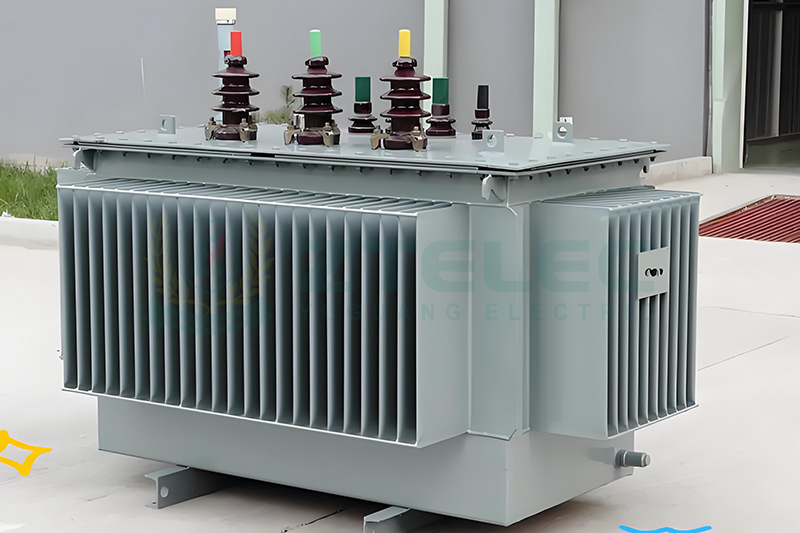
Key Parameters and Capacity Ratings of Oil-Immersed Transformers
1. Capacity Ratings
According to GB/T 6451-2023, standard transformer capacities include 30 kVA, 50 kVA, 100 kVA, 315 kVA, 630 kVA, 1000 kVA, 5000 kVA, up to 100 MVA. Units with 500 MVA and above fall into ultra-large-capacity transformers and require custom manufacturing. These are mainly used in backbone substations and typically follow IEC 60076 standards.
2. Core Parameters
Rated Capacity: The maximum continuous output power under rated conditions. For example, a 630 kVA transformer supports approximately 504 kW at a 0.8 power factor.
Load Factor: For long-term operation, the load factor should not exceed 80% to avoid overheating and maintain efficiency.
Energy Efficiency Level: Under GB 20052-2020, a Level-1 energy-efficient 1000 kVA transformer must meet no-load loss ≤ 1.15 kW and load loss ≤ 10.3 kW.
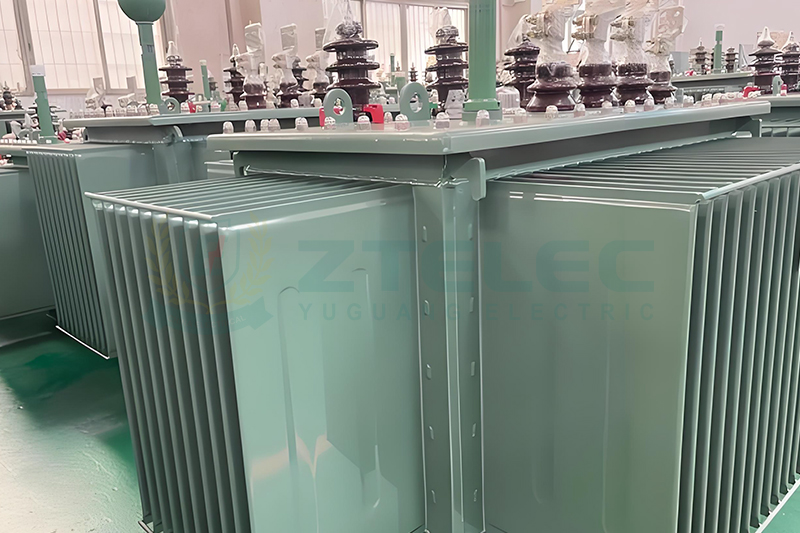
Calculation and Selection Steps for Transformer Capacity
1. Calculate the Total Load
Begin by listing the total electrical power of all equipment connected to the transformer. Resistive loads such as lighting and heating are added directly. Inductive loads such as motors require consideration of starting current and operating probability. Apply demand factors and load factors to determine the effective load.
Formula: Calculated load (kW) = Total equipment power × Demand factor
2. Convert to Apparent Power (kVA)
Transformer capacity is rated in kVA, so convert total active power using the power factor (Cosφ).
Formula: Transformer capacity (kVA) = Calculated load (kW) / Power factor
If detailed data is unavailable, assume Cosφ = 0.8 during planning.
3. Reserve Margin for Future Expansion
To accommodate future load growth, reserve an additional 15%–25% on top of calculated capacity. This ensures long-term flexibility without causing efficiency losses from excessive oversizing.
Final formula: Selected capacity (kVA) = Required capacity × (1 + Reserve factor)
4. Match Standard Capacity Levels
Since calculated capacity rarely matches standard ratings, select the next higher standard level. Common ratings include 50, 100, 160, 250, 315, 400, 500, 630, 800, 1000, 1250, 1600, and 2000 kVA.

Common Selection Mistakes and Correct Approaches
Incorrect Practice: Choosing based solely on daily energy usage.
Consequence: Continuous high-load operation and overheating.
Correct Approach: Calculate maximum expected load with proper demand and load factors.
Incorrect Practice: Oversizing to “play safe.”
Consequence: High initial cost and long-term no-load losses.
Correct Approach: Match capacity scientifically to actual load requirements.
Incorrect Practice: Ignoring future load growth.
Consequence: Transformer replacement within a few years.
Correct Approach: Reserve 20%–30% margin for expansion.
Incorrect Practice: Not considering impact loads or motor starting currents.
Consequence: Voltage dips and equipment tripping.
Correct Approach: Increase capacity by 15%–25% when large motors or surge loads are present.
Key Points for Choosing an Oil-Immersed Transformer Supplier
When selecting a supplier, consider certifications such as ISO9001, ISO14001, CE, CB, and SGS. Ensure the manufacturer supports non-standard customization including Dyn11/Yyn0 connection groups and adjustable parameters. Confirm their capability to provide special models such as high-altitude, high-temperature, low-noise, and energy-saving types. Evaluate compliance with IEC 60076 and GB 1094 standards, and review project cases from global regions such as South America, Southeast Asia and the Middle East. A reliable supplier ensures stable operation and minimizes long-term maintenance costs.
Accurate transformer capacity selection involves more than simple calculations. It requires understanding load characteristics, future expansion plans, application scenarios, and grid conditions. Whether you are planning an industrial plant expansion, commercial complex, data center, or renewable energy project, selecting the right transformer capacity ensures long-term efficiency, safety and cost savings. Contact us anytime for professional transformer sizing and technical support.